Landing gear
Functional principle
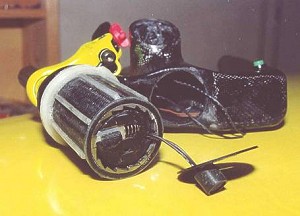
On the handlebar there´s a grip shifter. This shifter pulls over a rope, which runs through the stem and
under the seat , on a "distributor", where the rope tension gets distributed in 3 functions
( starting with the landing gear outside ) :
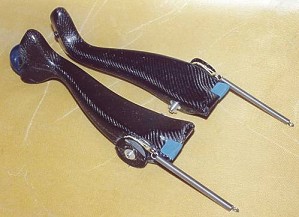
First the arms are unlocked by pulling the locks on the back of the seat.
Then the arms are retracted into the fairing.
And last the flaps in the fairing have to be retracted.
To bring the landing gear outside there´s a small lever with the function to unlock the stepped inset
of the grip shifter. After pushing the lever the flaps are opened by rubber bands and the arms
fold down by gravity and spring tension. In this position they click shut into the locks behind the seat.
Whereas retracting the landing gear takes a few seconds, opening it out is finished in less than
a second. You can see on two lights in the cockpit if the arms are really completely outside.
The wheels are modified rollers from inline-scates.
Advantages-
Easier start and stop
-
No cramps by supporting with the legs
-
The shoes are inside the pedals at the start -> faster start
-
Easy slow maneuvers ( e.g. at intersections or when getting
in lane before the race starts, etc. ) -
Starting is also possible uphill
-
No flaps for the feet in the fairing necessary --> the necessary
flaps for the landing gear arms are better put in the tail area
with regard to statics ( the supporting bodywork has not to be
broken through ) and aerodynamics -
Safe standing position , therefore easy getting in --> smaller
manhole necessary --> more bodywork stiffness
Disadvantages-
Additional weight about 1000 g
-
Extreme forces are imported from the gear arms
to the seat and the bodywork -
More breakable parts
-
Danger for overturning on streets with too much crossfall